

Depending on how you look at it, Artificial Intelligence (AI) has been around for hundreds years already. Yes, you read right – hundreds!
Eye-watering amounts of money have been spent on this technology across the world for far longer than we realise! It’s been used in large manufacturing firms forever, and on the back-end of all the tech giants’ platforms, in medical, travel, entertainment, and of course, in the defense field to list a few.
The point is – we don’t need to be afraid of something that has been around this long already. We can be frustrated and overwhelmed yes; but technology is our servant, not the other way around. We can adapt, learn and embrace where we need to, and use critical thinking to decide what’s good for us.
So while the tech giants who made all these tools scream on the one hand “we’re all gonna die“; with the other hand they are making trillions of dollars from this game and have been approved to merge humans with machines. Right. The globalist agenda in full swing again. A subject for another day.
In the meantime, the rest of us have lives and a job to do.
The difference now is that AI has now gone mainstream thanks to something called Large Language Models – which is what ChatGPT, Bard, Bert, Copilot and Bing Chat are. The man on the street now has AI at his fingertips as long as he has internet access. Regulation of the AI world on government level is inconsistent at best, they are behind the curve in most aspects; so basically, it’s a massive free-for-all right now. We have to regulate ourselves – but we don’t need government to tell us what is right and wrong anyway, we already know that.
So what does this mean for companies and business owners?
We have been unwavering crusaders for strategy and governance of complex and disruptive technologies for nearly 2 decades at Lets Collaborate, and we have every intention of continuing that stance in the AI world. As we all adopt these tools to streamline operations, enhance productivity, and create solutions; we must consider the implications of their use. Businesses can be elevated to another level completely by embracing technology or be brought to its knees by under-estimating the management of it.
Let’s break it down to start chipping away at the task that lies ahead of us.
Strategy and Governance
Adopting AI in a business opens up a huge list of opportunities as well as challenges. From a strategic standpoint, it is essential to align the AI strategy with the company’s vision, mission, values and standards. It’s time to get honest about the purpose of AI in your business. Why are you choosing to leverage AI tools now if you have not done so before?
Is it because all the ‘cool kids’ are doing it? Are you trying to get rid of inefficient and expensive staff? Are you trying to be a more digitally savvy business? Are you trying to build something quicker? Are you trying to get to market quicker? Or grow your social media following? Engage with your customers? Answering these and other questions will help you define the overall strategy for your company.
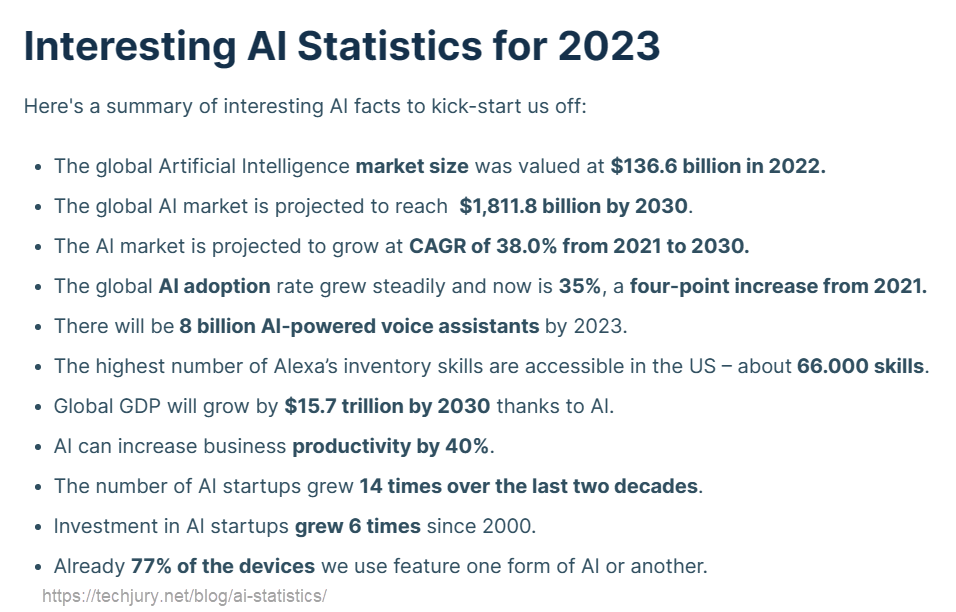
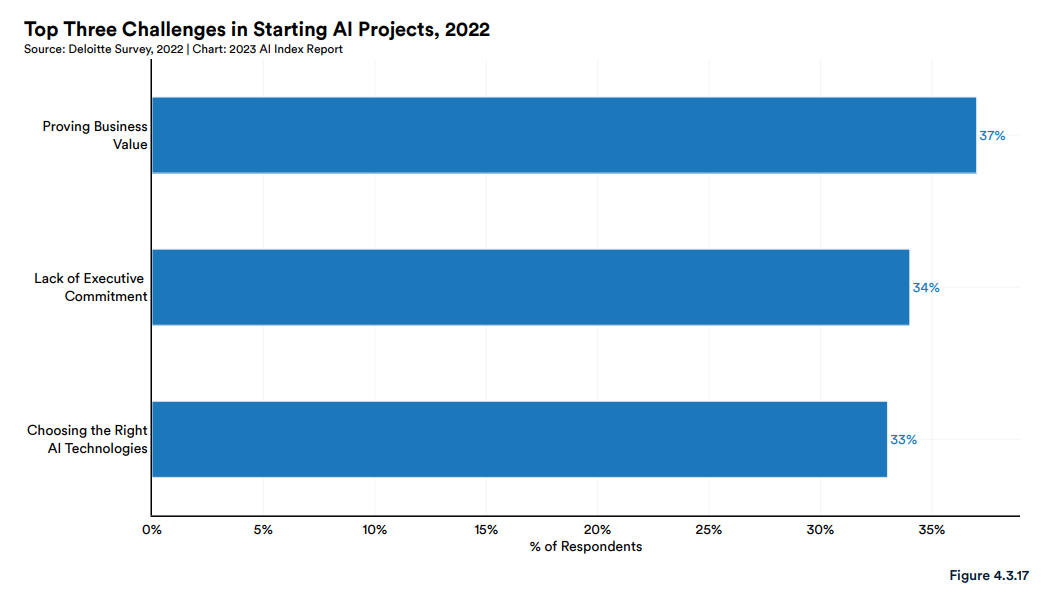
Here are some industry stats from Deloitte for 2022 to give you some ideas.

You need an overarching strategy to manage the over 1500 AI tools already available in the market place. Some of them are utterly useless, some of them are pretty amazing; and it is a frustrating, time-consuming, expensive journey figuring out which is which. What will you use, when, how and why?
Approximately a third of businesses surveyed by Deloitte are struggling with these decisions.
Once decided, it will take the combined efforts of Exco, Legal, HR, IT, Training and Marketing to successfully rollout those chosen tools for your AI strategy in a business. Complexity of the tools, lack of skills, fear of job losses and uncertain return on investment all compound the management of AI in a company. It requires strategic, executive buy-in and direction due to the financial, time investment and people implications it has to get it off the ground.
Let’s look at some implications in common department types in corporates. The list is not exhaustive. This is a large subject that will require many blogs to cover.
Legal Implications
AI can bring a new level of efficiency and precision to legal work using plugins, making services more accessible. However, it is important to acknowledge the risks that come with AI use, like hallucinations, inaccurate information, copyright infringement, defamation, and data protection breaches. It is crucial to have clear guidelines emphasizing adherence to local and international copyright, defamation, and data protection laws to mitigate these risks.
Policies and procedures need to be written establishing the rules of engagement, and that reinforce that final decision-making and oversight lies with humans and not with AI tools. The policies need to establish clear lines of responsibility for AI-generated content.
Make sure your websites’ Legal and Privacy Policies are updated to protect your stakeholders from AI technology like deepfakes.
HR and Training Implications
The use of AI in HR processes must be undertaken with respect for employee privacy, fairness, and an understanding and mitigation of potential bias, (it makes assumptions about certain demographics and pushed political agendas). Transparent guidelines need to be put in place to ensure this and reviewed regularly. The review process needs to be at least every 6 months to keep up with the rapid advancements in the AI field at this point.
Adopting AI technologies will likely lead to changes in job roles and responsibilities. Supporting employees through this transition, ensuring their well-being and engagement, and addressing their apprehensions is crucial to a positive work environment. Analyze how AI will impact different roles and plan for potential job redesigns, with internal communication plans to ensure employees understand AI’s effect on their roles.
Investing in upskilling and reskilling programs will equip employees with the necessary skills to work effectively alongside AI technologies.
Channels for employees to voice their concerns or ask questions about the introduction of AI should be available, promoting an inclusive culture that values human skills.
IT Implications
AI implementation requires robust IT infrastructure, rigorous cybersecurity, and careful data management. As part of this, there should be an ongoing investment in IT infrastructure, with strong cybersecurity measures in place to protect AI systems and data. The creation of comprehensive data governance policies is also crucial to guide data collection, storage, and use in AI applications, ensuring regulatory compliance.
It also impacts the hardware in the organisation, some laptops or computers may not have the computing power to handle some of the AI tools in the marketplace, requiring the hardware to be upgraded. This can add to the financial impact of AI.
Finance Implications
AI can speed up processing and analysis of financial data, enhance risk management, and aid in fraud detection. However, it’s essential to be aware of potential financial implications that could arise from hallucinating AI models! Blindly trusting AI to give accurate financial analysis and forecasting information could prove devastating to a business as it does not consistently or predictively provide accurate data.
Apart from that, there also needs to be a strategic investment plan for AI implementation covering costs related to the technology, training, infrastructure, and ongoing maintenance. This can run into millions of dollars depending on the industry and scope of the rollout.
Sales Implications
AI tools can improve customer targeting, personalize sales interactions, and streamline administrative tasks. Ensuring the accuracy of AI-generated information and managing customer perceptions are key to successful integration. Chatbots are widely used and can be trained on all your company data, allowing your customers to get accurate information on your products in natural language.
Sales staff need to be trained to use AI tools ethically and effectively and be prepared to address any customer questions or concerns about AI.
Marketing Implications
AI can exponentially enhance marketing efforts, but done wrong, could impact your brand reputation. However, content creation, social media strategies and SEO become a walk in the park using AI and are an invaluable tool in the ecommerce space.
Transparency in AI-driven marketing activities is important; customers should be aware when they are interacting with an AI, and their data usage rights should be clearly communicated.
Operational Implications
AI can increase efficiency, predict disruptions, and enhance quality control processes in operations. However, the implementation of AI can lead to significant costs and changes to existing processes. Most businesses move too slowly to keep up with these lightning-fast tools.
Operational contingencies should be in place in case of AI system failure or inaccurate results, ensuring minimal disruption to the business. A balance should be maintained between AI automation and human oversight in operational processes.
In Closing
We have a long journey ahead of us in the business world. The industry giants are ahead of the curve because they can afford to be so. But there are millions and millions of other businesses who have not had the budget nor expertise to go the AI route. The barrier to entry has been lowered now and that will start to change. Any business can be disrupted now, so your AI Strategy and Governance Plan (and roadmap) needs to be pushed up the priority list.
Our business has wasted no time on this, and of course we are using SharePoint (and OneNote) to organise this project.

As for Our Strategy
For me it is crystal clear :
If AI does not help me, my business partners, my company, the people I love, our clients, and the future businesses we want to help; exponentially improve their financial situation, whilst drastically freeing up their time, it’s not working.
Time will tell.
I have spent 6 months doing hours and hours of daily research and evaluation to find that sweet spot to achieve that goal. When I know what really works for us mere mortals and isn’t just clever marketing, you’ll be the first to know.
Just Remember
The smartest machine on earth – is the human being. And don’t let anyone tell you otherwise.

 Views from Veronique